Category: News
-

Most young people go online for fun – but they want to learn more
From a recent survey on media usage among 12-13 year olds in Ireland, it came as no surprise to learn that the most common reason cited for going online was fun. However, findings also revealed that school work scored just as highly, as did social networking. Not discounting social desirability implications of the ‘school work’…
-

How to Move People with Integrity?
“Like it or not, we’re all in sales right now… whether we’re teachers or art directors or in healthcare.” “Temperament, whether individual or collective, is not amenable to persuasion,” Joseph Conrad wrote in his reflection on writing and the role of the artist. And yet it seems to be through our temperaments, not our rational…
-

Future cyber threats to cause more headaches than ‘Heartbleed’
Tomorrow’s hackers could shut down infrastructure and defraud public sector of billions according to a new report released by CSIRO at CeBIT’s Cyber Security Conference. Many of these future attacks could take advantage of vulnerabilities similar to “Heartbleed”, a major internet security flaw which allows attackers to gain access to encrypted passwords, credit card details,…
-

Kazakhstan’s first Earth observation satellite has been placed successfully in orbit
Recently we have received the news from Airbus Defence & Space saying that Kazakhstan’s first Earth observation satellite has been placed successfully in orbit. Now we would like to explain what it is all about. KazEOSat-1, the Republic of Kazakhstan’s first Earth observation satellite, was successfully launched in night on 29th of April 2014 on…
-

Weekly Science Picks
We are at the end of one more exciting and scientifically promising week. It’s time to summarise what have happened during the last 7 days. As usual, the task was quite challenging, but we have obtained it. Here we would like to present the most interesting science and technology innovations of the week. Why bad…
-

CSIRO innovation could reduce brown coal emissions by up to 50 per cent
CSIRO and its industry partners plan to trial the Direct Injection Carbon Engine (DICE) in Victoria’s Latrobe Valley, the second largest and lowest cost brown coal resource in the world, with the aim of reducing emissions from brown coal-generated electricity by 50 per cent compared to current technology. Brown Coal Innovation Australia (BCIA) has allocated…
-

ANU delivers the world’s first Hindi-English MOOC
The Australian National University is offering the world’s first bilingual Hindi-English Massive Open Online Course (MOOC). The 10-week course, Engaging India, is a partnership between ANU and the global MOOC provider edX, which was founded by American universities Harvard and MIT. MOOCs are free courses, open to anyone around the world and delivered online. Engaging India already has…
-

Developing nations ride a motorcycle boom
Asia’s rapidly developing economies should prepare for a full-throttle increase in motorcycle numbers as average incomes increase, a new study from The Australian National University has found. Using data from 153 countries, researchers Dr Paul Burke and Dr Shuhei Nishitateno found the number of motorcycles per capita increases until average incomes reach around $8,000 per…
-

Weekly Science Picks
It’s time to summarise scientific contributions for this week. As usual, we would like to present the headlines which marked out the current week. The task was not the simple one, but we made it. Here are the most incredible things from the world of science and technology that have happened during this week. Reading…
-

Scientists find new way to fight Malaria drug resistance
An anti-malarial treatment that lost its status as the leading weapon against the deadly disease could be given a new lease of life, with new research indicating it simply needs to be administered differently. The findings could revive the use of the cheap anti-malarial drug chloroquine in treating and preventing the mosquito-bourne disease, which claims…
-

The Science of the World’s Most Popular Drug
Here’s a quick shot of science to start your day. The American Chemical Society, an organization representing chemists across the US, has released the latest in a series of Reactions videos. Attempting to explain the science of everyday things, previous Reactions videos have demystified the chemistry of Sriracha, Love, Pepper and more. This latest video…
-

Deregulation of student contributions
Vice-Chancellor Professor Ian Young and Chancellor Professor Gareth Evans have called for the deregulation of student contributions so Australian institutions can offer courses which better compete with those on offer from the world’s best universities. In an opinion piece published in The Australian, they said the proposal would provide the best outcome for students, and would allow universities to focus…
-
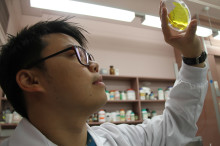
‘Botox of plastic’ to freeze power costs
A new material that prevents plastic from ageing has been developed by CSIRO – offering huge environmental and cost savings for the energy industry. When applied to plastic lining this ‘botox for plastic’ can clean up exhaust gases from power plants much more effectively than existing methods. Currently, the techniques industry use to separate out…
-

Two Artificial Intelligence Chatbots Talk to Each Other & Get Into a Deep Philosophical Conversation
The folks at the Cornell Creative Machines Lab are “interested in robots that create and are creative.” Here’s one such example of robots getting creative. Above, the lab lets two chatbots (essentially computer programs designed to simulate an intelligent conversation) start chatting with one another. They start by exchanging pleasantries. Then things get deeply philosophical,…