Category: News
-
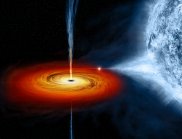
Black hole jets pack a powerful punch
High-speed ‘jets’ spat out by black holes pack a lot of power because they contain heavy atoms, astronomers have found. Black-hole jets recycle matter and energy into space and can affect when and where a galaxy forms stars. “Jets from supermassive black holes help determine a galaxy’s fate — how it evolves,” said CSIRO’s Dr…
-
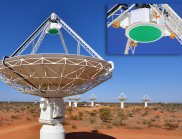
Lead role in Square Kilometre Array telescope R&D
CSIRO will play a lead role in the next stage of the development of the world’s largest radio telescope, the Square Kilometre Array (SKA), to be located in Australia and in Africa. This follows the SKA Organisation (SKAO) announcement that it has allocated R&D ‘work packages’ to consortia from around the world. The consortia, involving…
-

CSIRO Snapshot: November 2013
Today we provide a brief review of top CSIRO news published in the previous period. There was everything – from gum leaves to bushfires. Hope you will enjoy this journey. Spotlight – gum leaves rich in gold While money doesn’t grow on trees per se, we’ve found that precious gold does. We have revealed that…
-

Let’s fly through 17th century London!
Six students from De Montfort University have created a stellar 3D representation of 17th century London, as it existed before The Great Fire of 1666. The three-minute video provides a realistic animation of Tudor London, and particularly a section called Pudding Lane where the fire started. As Londonist notes, “Although most of the buildings are conjectural, the students used a realistic street pattern [taken…
-

Facts about Mars sample container
This spherical container has been engineered to house the most scientifically valuable cargo imaginable: samples brought back from the Red Planet. Still probably many years in the future and most likely international in nature, a Mars sample-return mission is one of the most challenging space ventures possible for robotic exploration. A robust, multifunctional sample container…
-
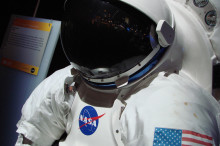
What would an astronaut do on Earth?
As Commander of the International Space Station, Chris Hadfield “captivated the world with stunning photos and commentary from space.” Perhaps you remember him singing David Bowie’s “Space Oddity” on board the International Space Station, or, on a more practical level, explaining what happens when astronauts shed tears in space –an important question, no doubt, but maybe not as…
-
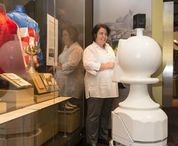
Robot rings in Phar Lap trifecta
For the first time, the body of Australia’s most famous racehorse Phar Lap will be brought together virtually using CSIRO’s Museum Robot at the National Museum of Australia. For many years Australia’s most famous horse has been in pieces. Phar Lap’s heart — currently preserved in a jar of formaldehyde – is at the National…
-
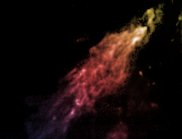
Galaxy been popping pills and hooked on gas for past 8 billion years
Our Galaxy may have been swallowing “pills” — clouds of gas with a magnetic wrapper — to keep making stars for the past eight billion years. That’s the conclusion of CSIRO astronomer Dr Alex Hill, lead author of a study of the Smith Cloud, a large gas cloud falling into our Galaxy from intergalactic space.…
-

Weekly Science Picks
Halloween week and we have a collection of scientific goodies for you to dig your teeth into. Some scary, others not, (does not contain smarties). Halloween’s Debt to a Demonic Virus “Our demons have their origins in our dread of death and the unknown. Today is Halloween, a time for costuming ourselves and confronting those…
-
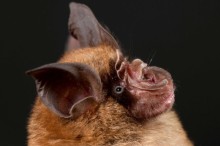
Bats confirmed as SARS origin
A team of international scientists has isolated a very close relative of the Severe Acute Respiratory Syndrome coronavirus (SARS-CoV) from horseshoe bats in China, confirming them as the origin of the virus responsible for the 2002-3 pandemic. The SARS-CoV pandemic killed 774 people of the 8094 people infected, a case fatality ratio of almost 10…
-

Plastic’s Reach
Plastic. Seems it has extended its reach into the farthest corners of the universe. An earliest post described how plastic has changed our lives, for better…and for worse. ADD link to earlier post. That post largely reflected on the growing problem of plastic in the oceans and the effect on plant and animal life. Now,…
-
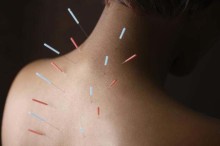
Alternative therapies – the facts
People have been using alternative therapies for thousands of years, long before scientific-based medicine became the norm. Defined as any form of medical treatment not covered by top medical school courses, alternative therapies come under many guises, from acupuncture and chiropractic to homeopathy and naturopathy. Many people will only use alternative therapies whereas others believe…
-
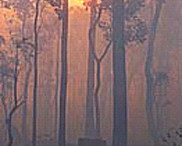
Bushfire in Australia
Bushfire has been part of the Australian landscape for millions of years but while we consider it a threat, some of our flora and fauna depend upon it. Much of Australia’s vegetation has evolved with fire and curiously, like the vegetation in other harsh dry environments, it has developed characteristics that promote the spread of…
-
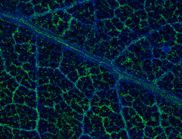
CSIRO discovers gold grows on trees
Scientists from CSIRO made the discovery and have published their findings in the journal Nature Communications. “The eucalypt acts as a hydraulic pump – its roots extend tens of metres into the ground and draw up water containing the gold. As the gold is likely to be toxic to the plant, it’s moved to the leaves…