Tag: NASA
-

Weekly Science Picks
It is with a heavy heart that I must say, this is my final set of Weekly Science Picks here on Australian Science. In fact, it’s to be the final set of Weekly Science Picks. Unfortunately, running a site like this one is a costly affair, and it’s been an honour to be a writer…
-
Weekly Science Picks
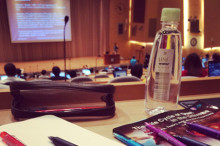
Well, it’s my turn to pick my favourite science news this week on Australian Science. And I must apologise for being slightly late with this. The reason is that I’ve only just got home to Tokyo after spending all week in Taipei for a conference on interstellar dust! As with any good conference, it’s been…
-
Weekly Science Picks
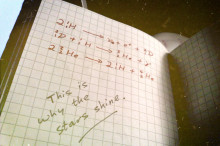
It’s Sunday again. Time for some science-y goodness from around the globe!! Mouse eats scorpion, feels no pain. The discovery that a type of mouse feels no pain from scorpion venom has revealed a new strategy for developing pain-killing drugs. Hubble to get boost from gravitational lensing Astronomers are attempting to boost the imaging prowess…
-
Weekly Science Picks
Welcome to this edition of Weekly Science Picks! Here’s a great little story to get us started about how one scientist found out about his Nobel Prize win this past week. He doesn’t carry a mobile. Prof Peter Higgs did not know he had won Nobel Prize by BBC News Nobel Prize-winning scientist…
-
Weekly Science Picks
Hello everyone. I hope you’ve all had a good week! It’s a balmy Autumn evening here in the UK where I sit as I write this – and I must say, this week’s science picks include something quite historic… Anyone with half an eye on the science news recently should know by now that it’s…
-
Weekly Science Picks
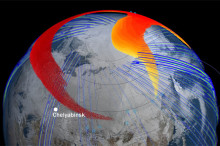
It’s that time of the week again. Time for some science-y goodness from around the globe!! NASA Spitzer Telescope celebrates 10 years in space! Ten years ago the Spitzer Space Telescope was launched about a Delta II rocket from Canaveral, Florida. Spitzer is an infrared telescope and is the fourth of the NASA’s four Great…
-
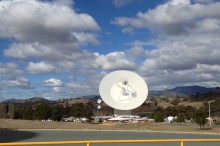
Space Open Day at the Canberra Deep Space Communication Complex
The Canberra Deep Space Communication Complex (CDSCC), located on the rural outskirts of Canberra at Tidbinbilla, is one of only three NASA deep space tracking stations spread around the globe. On Sunday 18th August, as part of National Science Week they held their biennial ‘Space Open Day‘, affording a rare opportunity for visitors to tour…
-
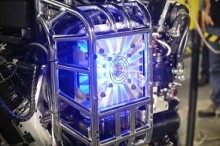
DARPA’s ATLAS Humanoid Robots
NASA is exploring peaceful civilian space applications for ATLAS-related technologies. Atlas is a new humanoid robot 6 foot, 2 inches tall weighing 330 pounds. Atlas is initially being designed to provide humanitarian assistance in disaster response/crisis situations. NASA’s Johnson Space Center (Valkyrie) and Jet Propulsion Laboratory(RoboSimian) teams are participating in the DARPA Robotics Challenge (DRC) focused on developing innovative…
-

Pluto’s new moons named: Spock still homeless
The dwarf planet, Pluto, can still generate plenty of public interest – if the naming of its two recently discovered moons is anything to go by. After their discovery, the leader of the research team, Mark Showalter, called for a public vote to suggest names for the two objects. The on-line contest, aptly named ‘Pluto…
-
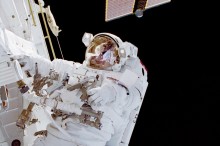
Could The Next Australian In Space Be A Paying Tourist?
A flurry of press articles went out this week after NASA announced its eight new astronaut candidates. The agency touted these people, who range from doctors to fighter pilots, as a generation of astronauts that will at last be trained for missions beyond Earth’s orbit. The agency is eyeing the moon, and Mars, as…
-

Weekly Science Picks
Greetings one and all, and a very happy science Sunday to you! This week’s generally been quite interesting. We’ve had good news, bad news, a little heated discussion… All the kind of things which keep the science community vibrant and interesting. As for specifically what that news was, well. Please do read on… First…
-
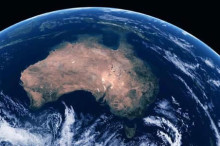
Australia from orbit
From December 19th last year, Chris Hadfield has been living aboard the International Space Station (ISS) in orbit roughly 400 km above planet Earth. Seeing 15 sunrises every day as the station tracks its way above our planet, the ISS, to quote Hadfield himself, “weighs 500 tonnes and is the size of 5 NHL hockey…
-
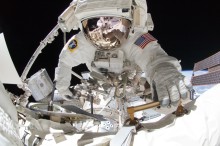
New light on dark matter: space station magnet attracts praise
Nobel prizewinner Samuel Ting, early Thursday morning (March 4, 2:00 AEDT), announced the first results from the Alpha Magnetic Spectrometer (AMS) search for dark matter. The findings, published in Physical Review Letters, provide the most compelling direct evidence to date for the existence of this mysterious matter. In short, the AMS results have shown an…
-
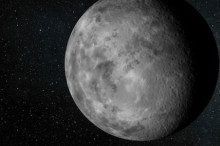
It’s a small world after all
What we know of exoplanets has developed at the same time as the technology which we use to discover them. This is, in my opinion, the most exciting thing about the entire field of study. For instance, when we first started spotting planets around alien suns, we found huge gas giants. Hot jupiters, extremely massive…