Author: Markus
-

Quantum computing: Australian researchers store data on a single atom!
Computers are everywhere these days. They play us music, tell us when to wake up, remind us that we’re late for an appointment, and provide us with entertainment. Even if we don’t realise it, so ingrained in our lives are computers that the world would be a very different place without them. Computing is also…
-

Mosquito-borne diseases: Fighting fire with fire
I have a decidedly “live and let live” approach to life. There are no animals in this world which I harbour any malicious feelings towards, regardless of how many of those animals would think nothing of poisoning, eating, maiming, or otherwise killing me (it’s a tough world out there). No animals, with one exception. I…
-
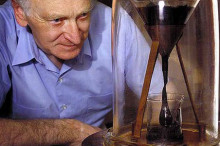
The World’s Slowest Experiment
What exactly is a liquid? It’s a seemingly basic question with an answer which may seem obvious to any of us. But as with so many things in science, it may not be as straightforward as you think. Of course you know what a liquid is, and the answer which may have come to mind…
-
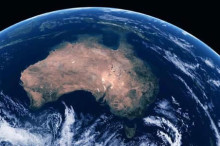
Australia from orbit
From December 19th last year, Chris Hadfield has been living aboard the International Space Station (ISS) in orbit roughly 400 km above planet Earth. Seeing 15 sunrises every day as the station tracks its way above our planet, the ISS, to quote Hadfield himself, “weighs 500 tonnes and is the size of 5 NHL hockey…
-
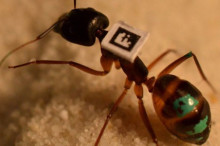
Weekly Science Picks
It’s been rather a turbulent week, all told. There’s been a lot going on in the news, both good and bad. Hopefully, this little handful of science news items will help you finish the last week and begin this next one on a lighthearted note! NASA’s Kepler mission has found a star system which…
-
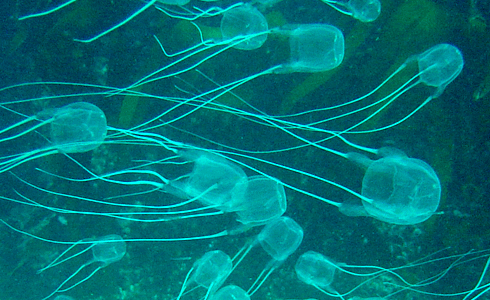
The Schoolchild who Discovered a New Jellyfish Species
The thing I love the most about scientific discovery is that anyone can do it. Literally anyone could, tomorrow, turn over a stone or look at a seemingly empty spot in the night sky and find something which no human being has ever seen before. Or, perhaps more importantly, something which no one has full…
-
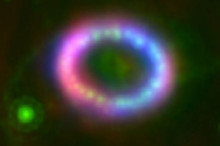
A Supernova Post-Mortem in Radio Waves
It was a late February night in 1987 when, standing on top of a Chilean mountain range, Ian Shelton saw something which no one had seen for centuries. Looking up in disbelief, he watched a star explode some 160 thousand light years away. Rushing to another observatory to check with someone else, he was initially…
-

Weekly Science Picks
Ahhh, the end of the week again. It seems that every time it’s my turn to give the weekly science picks, it’s been an interesting week in science. This leads me to believe that every week is an interesting week in science! Amongst other things, this week was the birthday of Albert Einstein – March…
-
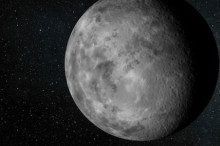
It’s a small world after all
What we know of exoplanets has developed at the same time as the technology which we use to discover them. This is, in my opinion, the most exciting thing about the entire field of study. For instance, when we first started spotting planets around alien suns, we found huge gas giants. Hot jupiters, extremely massive…
-
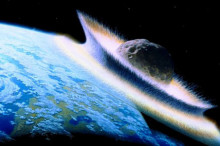
Asteroids, extinctions, and biodiversity: Wiping the slate clean for new life to flourish
The recent meteor strike in Russia has been a rather sobering reminder that Earth has been regularly battered during its history, by space rocks. Actually, the amount of meteoritic material constantly landing on Earth is startling – on average, over 100 tons every day which we don’t even notice. Now, most of that is in…
-
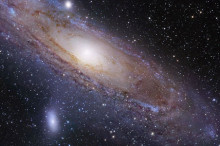
Andromeda and the 13 Dwarfs
Astronomy is quite notorious for being full of things we don’t entirely understand. Sometimes it really does feel as if the closer we look at the Universe, the less it makes sense. One thing in particular which seems to constantly evade our understanding is the way in which galaxies work. A lot of very smart…
-
Weekly Science Picks
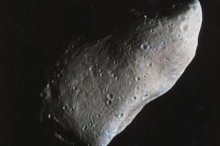
Ah, the end of the week. Time to relax, unwind, and look over the most interesting things to happen this past week in science. While I may be biased, being an astronomer, the most exciting things to happen recently have all been about space! The biggest news of the week was an asteroid passing so…
-

Rare echidna species not so extinct after all?
Speaking as a European, Australia has something of a reputation for having some rather unusual wildlife. Easily the most unusual are the small handful of monotreme species – the echidnas, and the duck-billed platypus. The only species of egg-laying mammals in the world today, these little creatures may once have been quite widespread. Now, however,…
-

Could the next generation of electronics be made with graphene?
While it may look like little more than molecular chicken wire, graphene really is wonderful stuff. A sheet of carbon atoms naturally forms into a geometrically perfect set of hexagons and, since it was first chemically synthesised in 2004, researchers across the world have been investigating its potential for uses in a wide variety of…